
There is a kind of tired that comes from doing too much.
And then there is the deeper kind.
The kind that comes from constantly leaving yourself to keep other people comfortable.
You say yes when your whole body says no.
You stay quiet because you do not want to upset anyone.
You make yourself easy to love, easy to manage, easy to need.
You keep swallowing your own truth and then wonder why you feel disconnected from yourself.
Babe, that is not peace.
That is self-abandonment dressed up as being “nice.”
And if you have been doing it for years, it makes sense that choosing yourself now feels awkward. It might even feel selfish. But it is not selfish to stop betraying yourself just to keep a connection alive.
It is necessary.
What self-abandonment actually looks like
Self-abandonment is not always dramatic.
Sometimes it looks like:
• laughing at something that hurt your feelings
• saying “it’s fine” when it is absolutely not fine
• agreeing to plans you do not have the energy for
• not asking for help because you do not want to be a burden
• staying in relationships where your needs are treated like an inconvenience
• making everyone else’s mood your responsibility
• talking yourself out of what you want before anyone else even has a chance to
It can look like being the strong one.
The reliable one.
The chill one.
The woman who can handle it.
But underneath all of that, you might feel resentful, unseen, tired, flat, and strangely far away from yourself.
That is usually the sign.
You have not lost yourself overnight. You have been leaving yourself in small moments for a long time.
Why you learned to do it
Most women do not wake up one day and decide to abandon themselves.
You learn it.
You learn it when being agreeable gets you approval.
You learn it when your needs are ignored, mocked, or turned into a problem.
You learn it when keeping the peace feels safer than telling the truth.
You learn it when love feels conditional.
You learn it when being “low maintenance” gets rewarded.
So you become easy.
Easy to please.
Easy to overstep.
Easy to rely on.
Easy to forget.
And for a while, it works.
People like you.
People need you.
People call you strong.
But inside, you start shrinking.
You stop knowing what you want.
You stop trusting your own feelings.
You stop asking yourself what you need because you have trained yourself to scan the room first.
That is the part nobody talks about.
Self-abandonment does not only change your relationships with other people. It changes your relationship with yourself.
The reframe: choosing yourself is not rejection
Choosing yourself does not mean you stop loving people.
It means you stop disappearing for them.
You can care about someone and still have a boundary.
You can love your family and still need rest.
You can be generous without giving past your capacity.
You can disappoint someone and still be a good person.
You can say no without writing a full legal defence.
You are allowed to be a whole person inside your relationships.
Not a role.
Not a helper.
Not an emotional support system.
Not a woman who only matters when she is useful.
A whole person.
With needs.
With limits.
With opinions.
With desires.
With a life of her own.
How to stop abandoning yourself
Start small, because this is not about becoming a completely different woman overnight.
It is about building evidence that you are safe to choose yourself.
- Pause before you answer
If your automatic response is always yes, start giving yourself space.
Try:
“Let me check and get back to you.”
That one sentence can change everything.
It gives you time to ask yourself the question you normally skip:
Do I actually want to do this?
Not “will they be upset?”
Not “should I be able to handle it?”
Not “what will they think of me?”
Do I actually want to do this?
That question brings you back to yourself.
- Stop calling your needs dramatic
You are allowed to need rest.
You are allowed to need clarity.
You are allowed to need affection.
You are allowed to need support.
You are allowed to need space.
Having needs does not make you difficult.
It makes you human.
The right people do not need you to become invisible so they can feel comfortable.
Read that again, because whew.
- Notice where resentment is speaking
Resentment is often a sign that you have crossed your own limits too many times.
Instead of judging yourself for feeling resentful, get curious.
Ask yourself:
Where did I say yes when I meant no?
Where did I stay quiet?
Where did I expect someone to notice I was struggling instead of telling the truth?
Where am I giving from fear instead of love?
Resentment is not always proof that someone else is terrible.
Sometimes it is proof that you have been abandoning yourself and calling it kindness.
- Tell the truth sooner
You do not need to wait until you are angry, exhausted, or ready to explode.
You are allowed to tell the truth while it is still small.
“I do not have the capacity for that this week.”
“I need some time to think about it.”
“That does not work for me.”
“I felt hurt when that happened.”
“I want to do this differently.”
The goal is not to control how the other person reacts.
The goal is to stop making your truth disappear.
- Let people be disappointed
This is the hard one.
Some people will not love your boundaries.
Especially if they benefited from you not having any.
Let them be disappointed.
Let them adjust.
Let them have feelings without rushing in to fix everything.
You are not responsible for making every person comfortable with the version of you who finally started choosing herself.
That version of you is not wrong.
She is awake.
What coming back to yourself feels like
At first, it might feel uncomfortable.
You might feel guilty after saying no.
You might over-explain.
You might worry people are mad.
You might want to take everything back and become easy again.
That does not mean you made the wrong choice.
It means your nervous system is learning something new.
Over time, it starts to feel different.
You begin to trust yourself again.
You stop needing everyone to agree with your choices.
You notice what drains you sooner.
You recover your opinions.
You stop performing “fine.”
You feel less resentment because you are no longer giving yourself away in pieces.
That is how you come back.
Not through one huge life overhaul.
Through tiny moments where you stop leaving yourself.
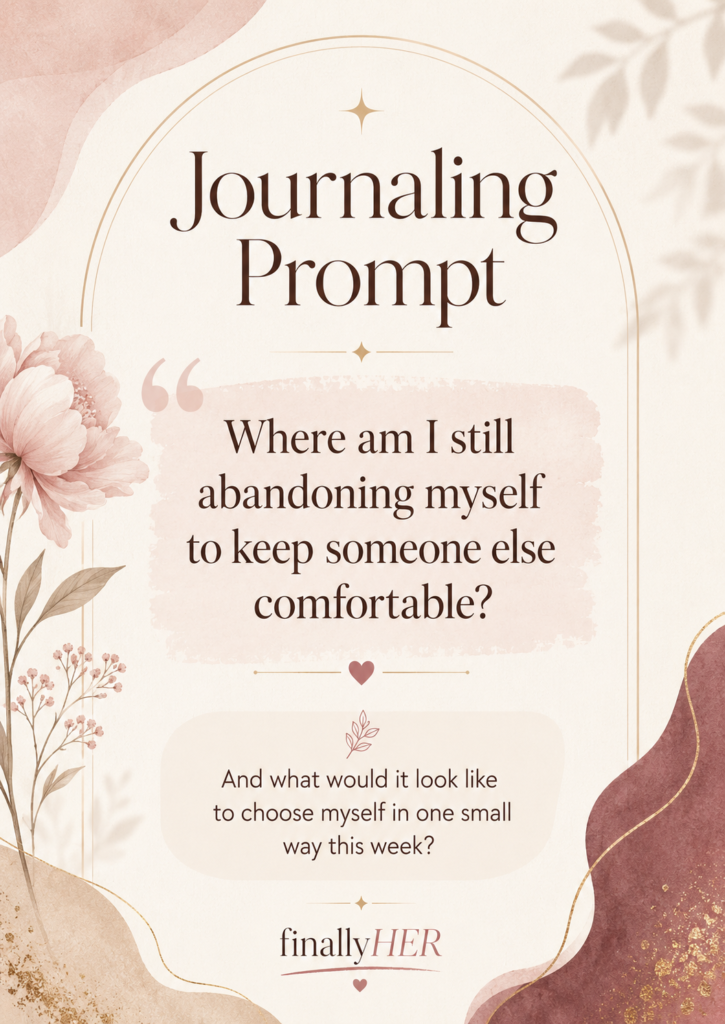
A journaling prompt for today
Where am I still abandoning myself to keep someone else comfortable?
And what would it look like to choose myself in one small way this week?
Do not overthink it.
One honest no.
One real answer.
One boundary.
One moment where you pause instead of performing.
One choice that proves you are no longer willing to disappear from your own life.
You do not need to become hard to stop abandoning yourself.
You need to become honest.
And you need to remember that love which requires you to leave yourself is not the kind of love you were made to build your life around.
You are allowed to come back to yourself.
Even if it disappoints people.
Especially then.